
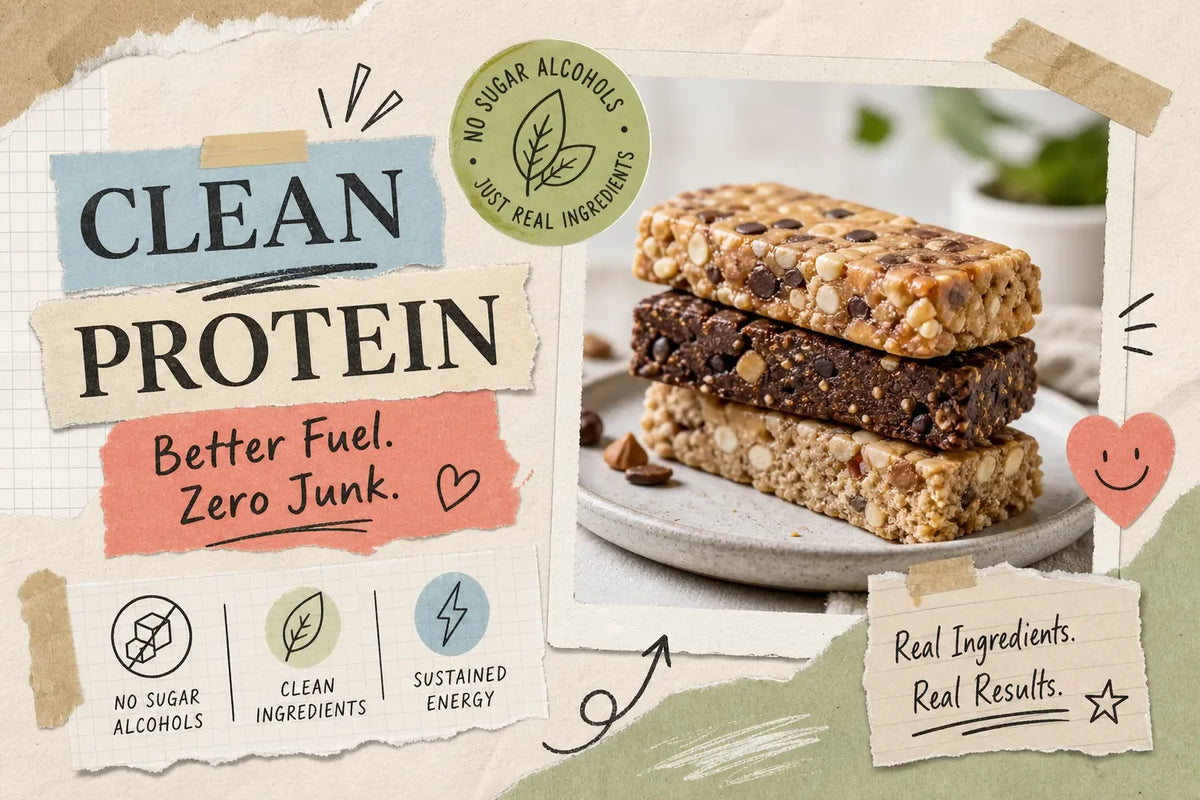
Best Protein Bars Without Sugar Alcohols: 8 Clean Picks
Best Protein Bars Without Sugar Alcohols: 8 Clean Picks
If you've been asking what are the best protein bars without sugar alcohols, you're not alone, and you're asking the right question. Picture this: you're scanning an ingredient label at 10 p.m., trying to figure out if the bar in your hand is actually clean. You've already put back two that had maltitol. A third had erythritol buried near the bottom. The "low sugar" claim on the front means almost nothing at this point.
The search for protein bars without sugar alcohols isn't a niche concern. It's practical. Polyols are common in many keto-friendly, low-sugar, and high-protein bars, not because they're the best option, but because they let manufacturers claim reduced calories and minimal sugar impact on the nutrition label. For people with IBS, FODMAP sensitivity, or simply a gut that doesn't handle polyols well, those bars aren't a shortcut. They're a problem.
This article gives you eight specific bars that skip the sugar alcohols entirely, a quick label-reading method you can use anywhere, and a framework for matching the right bar to your actual diet and goals.
Why so many protein bars rely on sugar alcohols, and why it often backfires
The incentive is straightforward: sugar alcohols let manufacturers reduce calorie counts, lower the glycemic index, and market a bar as "low sugar" without using real sugar or artificial sweeteners. FDA labeling rules allow sugar alcohols to be counted at a reduced calorie value compared to regular sugars, which can make a bar look leaner on paper. That's a meaningful marketing advantage when your buyer is comparing labels in a grocery aisle.
What sugar alcohols actually do inside your gut
Polyols are poorly absorbed in the small intestine. The unabsorbed portion draws water in through osmosis and then gets fermented by colonic bacteria, producing gas, bloating, and, in larger amounts, diarrhea. The effect is dose-dependent: maltitol and sorbitol are the worst offenders, with sorbitol causing symptoms in many adults at around 20 g per day. Erythritol is generally better tolerated, with significant GI effects appearing closer to 50 g, but it's not without risk for sensitive individuals.
The people who feel it most are those with IBS or FODMAP sensitivity, bariatric surgery patients, and anyone already consuming multiple polyol-containing products in a day. That last group is larger than it sounds. A bar, a protein shake, and sugar-free gum after lunch can stack quickly. One more thing worth knowing: a label showing "0 g sugar alcohols" doesn't guarantee there are none. Amounts below 0.5 g round down to zero, so the ingredient list is more reliable than the nutrition panel alone.
What Are the Best Protein Bars Without Sugar Alcohols? Start with the Label
The "-itol" ingredient check
The rule is simple: scan the ingredient list for any word ending in "-itol." Maltitol, erythritol, sorbitol, xylitol, isomalt, mannitol, lactitol, all are sugar alcohols. If you see one, you have your answer regardless of what the nutrition panel says.
Allulose is worth distinguishing here. It's a rare sugar that behaves differently from polyols, is often better tolerated than polyols for many people, and doesn't appear as a sugar alcohol on a label. You'll find it in certain protein bars and beverages. It isn't classified as a sugar alcohol, so don't let it stop you from an otherwise clean bar.
Sweetener alternatives that don't cause the same problems
Dates, monk fruit extract, and stevia are the most common cleaner sweeteners in this category. Because they aren't polyols, they sidestep the osmotic and fermentation issues that cause polyol-linked GI symptoms. Date-sweetened bars carry natural sugars, which matters if blood sugar management is a priority. That's not a reason to avoid them; it's just context worth having before you choose.
Truce: the bar built around what isn't in it
Most bars in this space force a trade-off: clean ingredients or meaningful fiber, good protein or no sugar alcohols. Rarely all four in one place. Truce was built specifically to close that gap. It contains no erythritol, no xylitol, and no maltitol. It's sweetened with dates, monk fruit, and stevia, and formulated with a prebiotic fiber complex from oats, chicory root, and tapioca fiber, which makes it functionally distinct from a bar that's simply "less bad."
What makes it different from every other bar on this list
Truce was developed to prioritize fullness, gut comfort, and clean ingredients first, with the nutrition following from those decisions rather than driving them. Each bar delivers 16 g of prebiotic fiber (57% of the daily value) and 15 g of complete vegan protein from a tri-blend of soy crisps, pea protein, and brown rice protein, with no seed oils and no artificial flavors. The flagship Cacao Almond Crisp earns consistent customer reviews praising it as tasting homemade rather than supplement-adjacent, and it keeps most people full for four or more hours. It functions as a meal, not just a snack. Available via one-time purchase or a flexible subscription.
7 more bars that skip the sugar alcohols
Date-sweetened picks: RXBAR and GoMacro
RXBAR keeps its ingredient list short: dates, egg whites, nuts, and a few flavor-specific additions, no sugar alcohols at all. Protein lands around 12 g per bar with roughly 4 g of fiber. It's not a high-fiber option, but it's genuinely clean and widely available. The main limitation is that it's not vegan, since it relies on egg whites for its protein base.
GoMacro leans plant-based and uses brown rice syrup and natural sugars for sweetness. Protein sits around 10 to 12 g depending on the flavor, with lower fiber than Truce. It's a solid whole-food choice and carries both certified gluten-free and certified vegan labels from third-party organizations, useful credentials if those matter for your diet.
Stevia and monk fruit options: ALOHA, IQBAR, and NuGo Slim
ALOHA is organic, plant-based, and dairy-free. It uses monk fruit as its primary sweetener, delivers around 14 g of protein per bar, and avoids erythritol entirely. It's one of the more accessible bars in this category, available at Target and other mass retailers for roughly $2 per bar in multipacks. Look for "gluten-free" on the label and verify third-party certification if celiac disease is a concern.
Where ALOHA leads with accessibility, IQBAR takes a different angle: it uses stevia and positions itself around brain health. Lower in calories and carbs, it's a reasonable fit for people watching net carbs carefully. The ingredient list is clean and the price is competitive, around $2.08 in a standard 12-count box. NuGo Slim is worth checking by specific flavor rather than by brand, since some formulations avoid sugar alcohols and others don't. Verify the individual wrapper before buying.
Simpler whole-ingredient options: KIND Protein and Rise Bar
KIND Protein bars typically avoid maltitol and erythritol, relying on honey and glucose syrup for sweetness. The texture is nut-based, protein lands around 12 g, and they're widely available at mass-market prices of roughly $1.80 to $2.20 per bar. Honey disqualifies them for strict vegans, which is worth noting if that applies to you.
Rise Bar stands out for having some of the shortest ingredient lists in the category, often three to five ingredients, no sugar alcohols, and no complex protein isolate blends. It's the right choice for anyone prioritizing minimal processing above everything else, with protein around 15 g per bar depending on the variety. The trade-off is lower fiber and less functional nutrition than Truce, but as a clean, simple option it delivers on what it promises.
How to Choose the Best Protein Bars Without Sugar Alcohols for Your Goals
Vegan, gluten-free, and dairy-free: what actually qualifies
Truce, ALOHA, IQBAR, and GoMacro are the strongest all-three fits on this list. RXBAR contains egg whites, so it's not vegan. Rise Bar's whey-based varieties are dairy-derived. KIND Protein uses honey, which disqualifies it for strict vegans. Gluten-free certification is separate from ingredient claims. If celiac disease is a concern, look for the certified symbol on the packaging rather than relying on "gluten-free" language, which isn't always third-party verified.
Keto, budget, and high-protein priorities
Being sugar-alcohol-free doesn't automatically mean keto-friendly. Date-sweetened bars can carry 20 or more grams of net carbs, so check total carbohydrates minus fiber on the label rather than relying on "low sugar" claims. For strict keto, IQBAR and No Cow are among the clearest fits on this list, both keep net carbs low without relying on polyols, though you should verify current net-carb figures on the label for the specific flavor you're buying. For budget, ALOHA and KIND Protein are the most widely available at mass-market prices. For the combination of protein, fiber, and clean ingredients in one bar, Truce stands out, particularly on the fiber side, where its prebiotic complex puts it in a category of its own.
The bottom line: finding a bar your gut will actually thank you for
Still wondering what are the best protein bars without sugar alcohols? The eight bars above prove that skipping polyols doesn't mean sacrificing protein, taste, or fullness. You just have to know what to look for. The "-itol" scan on an ingredient list takes ten seconds and tells you more than the front label ever will.
Most of these options are easy to find online or in stores. If you want one bar that handles fiber, protein, digestive comfort, and clean sweeteners without asking you to compromise on any of them, Truce is a strong place to start. It's what happens when a bar is built to solve a real problem rather than to hit a marketing claim. A one-time order or a flexible subscription are both available, check the terms on their website to find the option that fits.
Read more
Not all fiber is equal — concentrated additives ferment fast and cause bloating, while whole-food sources don't. Here's how to read a fiber bar label, spot sugar alcohols, and tell a functional bar...
Protein has dominated wellness for two decades, but 95% of Americans still fall short on fiber. Here's why prebiotic "fiber stacking" delivers steadier satiety, gut health, and glucose balance than...