
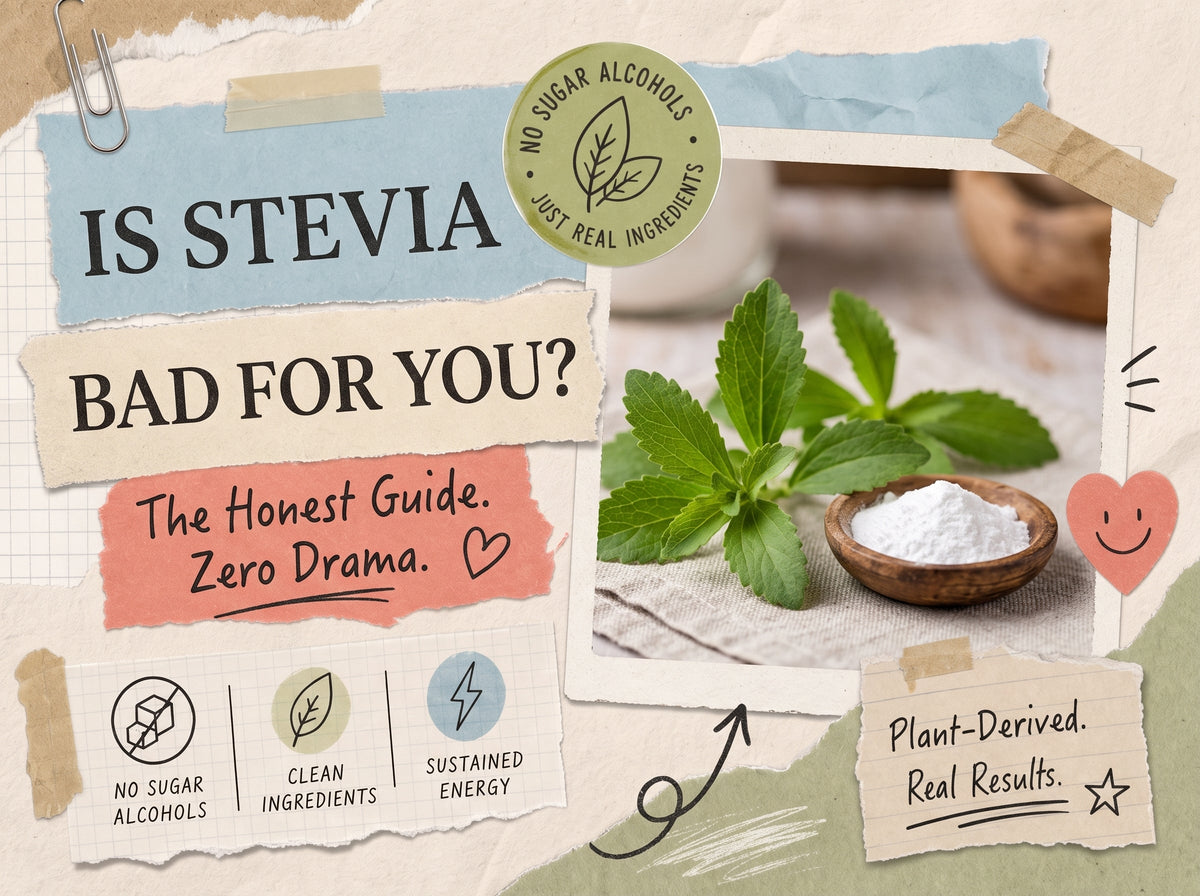
Is Stevia Bad For You? - Everything You Need To Know!
If you've typed "is stevia bad for you" into a search bar, you're probably standing in a grocery aisle holding two products — one sweetened with sugar, one with stevia — trying to decide which one deserves a spot in your cart. It's a fair question, and the honest answer isn't a simple yes or no. It depends on the form of stevia, how much you're consuming, what it's blended with, and what you're comparing it against.
This guide answers the question in full, section by section, using the actual regulatory history and research behind stevia rather than headlines. By the end, you'll know exactly how to decide for yourself.
1. What is stevia, and where does it come from?
Stevia is a sweetener derived from the leaves of Stevia rebaudiana, a small shrub native to Paraguay and parts of Brazil, where it grows wild in the border regions near the Amazon basin. Indigenous Guaraní communities have used the plant for centuries, calling it ka'a he'ê — "sweet herb" — and using it both to sweeten food and in traditional medicinal preparations.
The sweetness in stevia leaves comes from a group of naturally occurring compounds called steviol glycosides. The two most abundant are stevioside and rebaudioside A (often shortened to "Reb A"), though the plant contains more than a dozen distinct glycosides, including rebaudioside D and rebaudioside M, which have become increasingly important in recent years. These compounds are 200 to 300 times sweeter than table sugar by weight, which is why stevia products use such small quantities per serving.
2. How did stevia become a mainstream sugar substitute? The journey, explained
Stevia's path to your pantry shelf took decades, and it wasn't a straight line.
Early use in Japan (1970s): Japan was the first country to adopt stevia at scale, incorporating it into food and beverages after regulators there approved it as a sweetener. For years, Japan remained the largest commercial market for stevia while most of the world had never heard of it.
A rocky start in the U.S. (1990s): Stevia leaf and crude extracts entered the U.S. market as a dietary supplement in the mid-1990s, following the passage of the Dietary Supplement Health and Education Act of 1994. But as a food additive — meaning an ingredient added directly to processed foods and beverages — the FDA held back. In the early 1990s, the agency issued an import alert on stevia, stating that the available toxicological data wasn't sufficient to classify it as a food additive or as generally recognized as safe (GRAS) for that use. This gap — legal as a supplement, not yet cleared as a food additive — is the root of a lot of the confusion and conspiracy theories that still follow stevia today.
The turning point (2008): That changed in December 2008, when the FDA responded without objection to GRAS notifications for highly purified rebaudioside A, submitted independently by Cargill and Merisant/Whole Earth Sweetener Company. Crucially, this GRAS determination applied to highly purified steviol glycosides (95%+ purity), not whole leaf stevia or crude extracts — those remain unapproved as food additives in conventional foods to this day, though they're still sold legally as dietary supplements. Coca-Cola and Cargill launched Truvia that same year; PepsiCo followed shortly after with PureVia. Since then, the FDA has issued no-objection letters for more than 70 separate steviol glycoside preparations, including newer glycosides like rebaudioside M, which is produced through fermentation and prized for its cleaner taste.
Global regulators followed a similar path: Australia and New Zealand approved stevia as a food additive in October 2008, and the European Food Safety Authority (EFSA) followed with its own safety approval in 2011, setting an Acceptable Daily Intake (ADI) of 4 mg per kilogram of body weight per day, expressed as steviol — a figure the FDA also adopted.
3. What are the different forms of stevia?
Not all "stevia" on a shelf is the same product, and this is where a lot of consumer confusion starts.
- Whole leaf and crude extract: The least processed form, available as dried leaves or a green powder. This form is not FDA-approved as a food additive — it's sold only as a dietary supplement, and it carries the strongest, most bitter flavor of any stevia form.
- Purified steviol glycosides (Reb A): The most common commercial form, extracted and purified to 95%+ concentration. This is what first received GRAS status in 2008 and remains the basis for most tabletop sweeteners and food applications.
- Rebaudioside M and D: Newer, less-bitter glycosides, typically produced through a fermentation process (since they exist in only trace amounts in the raw leaf) rather than direct extraction. These are increasingly used in beverages and food products specifically because they reduce the bitter aftertaste associated with Reb A and stevioside.
- Liquid stevia drops/tinctures: Concentrated liquid extracts, often blended with water or alcohol, used for precise dosing in beverages and home cooking.
- Blended tabletop products (Truvia, PureVia, Stevia in the Raw): Important to know — most of the familiar packets on grocery shelves are not pure stevia. They're a small amount of purified steviol glycosides blended with a bulking agent, most commonly erythritol (a sugar alcohol) or dextrose, to replicate sugar's volume and texture for measuring and baking. If you're reacting to a "stevia" product, there's a reasonable chance the erythritol or other additive is the actual cause — more on that in the sugar alcohol comparison below.
4. What are the benefits of using stevia leaf extract in recipes?
Purified stevia leaf extract offers a specific set of practical advantages:
- Zero calories and zero glycemic impact. Steviol glycosides pass through the small intestine largely unabsorbed and aren't metabolized the way sugar is, so they don't raise blood glucose or insulin levels.
- Heat stability. Unlike some sweeteners that break down or lose sweetness under high heat, stevia holds up reasonably well in baking, though the lack of bulk and browning properties (the Maillard reaction that sugar drives) means recipes often need reformulation, not a 1:1 swap.
- Potency means less product. Because it's 200–300 times sweeter than sugar, a tiny amount replaces a much larger quantity of sugar, which matters for anyone managing total carbohydrate or calorie intake closely.
- Doesn't feed cavity-causing bacteria. Unlike sugar, steviol glycosides aren't fermented by oral bacteria in the mouth the way sucrose is, so it doesn't contribute to tooth decay the same way.
- Pairs well with other natural sweeteners. Many formulators blend stevia with monk fruit or small amounts of date sugar specifically to round out its flavor profile — a strategy that shows up often in better-formulated bars and beverages.
5. How does stevia taste compared to sugar, and what's the aftertaste problem?
This is the single biggest consumer complaint about stevia, and it has a specific biochemical explanation.
Sugar triggers your sweet taste receptors quickly and the sensation fades quickly too. Stevia's sweetness onset is slower, and — more noticeably — it lingers longer after you've swallowed. Many people describe a bitter, licorice-like, or metallic aftertaste, especially with stevioside and lower-purity Reb A extracts.
The cause: certain steviol glycosides, particularly stevioside and rebaudioside C, bind not only to sweet taste receptors but also to bitter taste receptors (specifically hTAS2R4 and hTAS2R14) on the tongue. That dual binding is what produces the characteristic bitter, lingering edge.
This is also why not all stevia tastes the same. Highly purified Reb A has a noticeably cleaner profile than whole leaf extract. Rebaudioside M — the newer, fermentation-derived glycoside — was specifically developed because it binds far less to bitter receptors, giving it the cleanest, most sugar-like taste of any commercially available steviol glycoside. If you've tried stevia once years ago and found it unpleasant, a product formulated with Reb M today may taste meaningfully different.
6. Why does stevia get a bad reputation in the media?
A few different threads feed into stevia's persistent image problem:
- Its own regulatory history. The FDA's early 1990s import alert — years before the 2008 approval — created a lasting "the FDA tried to ban this" narrative that conspiracy-minded coverage has kept alive, sometimes framed as pharmaceutical or artificial-sweetener industry lobbying against a natural competitor. While that history is real, it predates the current, more thoroughly studied form of stevia by nearly two decades.
- Guilt by association. Stevia frequently gets grouped in general "artificial sweeteners are bad for you" coverage alongside aspartame, sucralose, and saccharin — even though stevia is plant-derived and has a meaningfully different safety and research profile than synthetic sweeteners.
- Sensational coverage of animal studies. Several studies over the decades used doses of stevia or steviol far beyond what any human would realistically consume, then generated headlines that didn't caveat the dose. Regulatory bodies (FDA, EFSA, JECFA) have reviewed this body of research and set the ADI specifically to stay well below any level associated with adverse effects.
- Misattributed blame for blended products. Because most tabletop "stevia" products are actually mostly erythritol by volume, GI symptoms caused by the sugar alcohol often get blamed on "stevia" in consumer reviews and anecdotal reporting, further muddying the public's understanding of what's actually causing the reaction.
7. Does stevia have any side effects?
For the vast majority of people, purified steviol glycosides consumed within the established ADI (4 mg/kg body weight per day, as steviol) are well tolerated. That said, a few things are worth knowing:
- Allergic reactions are possible but uncommon. Stevia is part of the Asteraceae (daisy) family, which also includes ragweed, chrysanthemums, and marigolds. People with known allergies to these plants may have a higher chance of a cross-reaction to stevia.
- Mild GI symptoms are usually about the blend, not the stevia itself. As noted above, bloating or digestive discomfort attributed to "stevia" products is frequently caused by the erythritol or other sugar alcohol used as a bulking agent, not the steviol glycosides.
- Gut microbiome research is reassuring so far. Multiple recent human trials — including a 12-week randomized controlled study published in Nutrients in 2024 and a Cargill-funded study comparing stevia to sucrose — found no significant changes in gut microbiome composition, diversity, or short-chain fatty acid production from regular stevia consumption at realistic doses. This stands in contrast to some research on other non-nutritive sweeteners, which has shown more pronounced microbiome effects.
- Possible mild effects on blood sugar and blood pressure. Some research suggests stevia may have a modest blood-sugar-lowering and blood-pressure-lowering effect in certain contexts. This is generally framed as a benefit, but it's a reasonable reason for people on diabetes or blood pressure medication to check in with their doctor rather than assuming stevia has zero physiological effect.
8. How does stevia compare with monk fruit?
Stevia and monk fruit are often mentioned in the same breath because they're the two most prominent plant-derived, zero-calorie sweeteners on the market, but they come from different plants and different compounds.
- Source and compound: Stevia's sweetness comes from steviol glycosides extracted from leaves. Monk fruit (luo han guo) gets its sweetness from mogrosides, extracted from the fruit of Siraitia grosvenorii, a plant native to southern China.
- Taste: Many people find monk fruit's aftertaste less pronounced or bitter than stevia's, though this varies by individual and by the specific product's purity and blend — plenty of people find the reverse true.
- Regulatory status: Both are GRAS in the U.S., though monk fruit reached that status more recently and has a shorter track record of large-scale commercial use and human research simply because it entered the mainstream Western market later than stevia.
- Cost and availability: Monk fruit extraction is generally more expensive and less scalable than stevia, which is part of why it's less ubiquitous in processed foods, though that's changing as demand grows.
- In practice: Many well-formulated products — including a number of bars and beverages on the market — blend stevia and monk fruit together specifically to balance out each one's individual taste quirks, landing on something closer to sugar's flavor profile than either sweetener alone.
9. How does stevia compare with sugar alcohols?
This comparison matters because sugar alcohols (erythritol, xylitol, maltitol, sorbitol) are so frequently blended with stevia that consumers often conflate the two.
- What they are: Sugar alcohols are carbohydrates with a chemical structure partway between sugar and alcohol. Unlike stevia's steviol glycosides, they do provide some calories (except erythritol, which is close to zero) and some do raise blood glucose modestly.
- Digestive tolerance: This is the biggest practical difference. Sugar alcohols are poorly absorbed in the small intestine; the unabsorbed portion draws water into the gut and gets fermented by colonic bacteria, producing gas, bloating, and — at higher doses — a laxative effect. Maltitol and sorbitol are the most likely to cause symptoms, with sorbitol causing issues for many adults around 20g per day. Erythritol is the best tolerated of the group, with symptoms typically appearing only above roughly 50g, but it isn't symptom-free for everyone. Stevia, by contrast, has shown minimal gut disruption in recent human trials, as noted above.
- A newer concern specific to erythritol: Recent research has raised questions about a possible association between elevated blood erythritol levels and cardiovascular risk markers, including blood clotting activity. This research is specific to erythritol — it has no bearing on pure steviol glycosides, which is a meaningful distinction if you're evaluating a product that lists both ingredients separately.
- Functional role: Sugar alcohols provide bulk, texture, and browning properties that stevia alone can't replicate, which is exactly why they're blended together so often in baking and tabletop products — it's a functional trade-off, not an accident.
10. What are the most common products where stevia is used?
Stevia shows up across a wide range of categories:
- Diet and zero-sugar sodas and flavored waters
- Tabletop sweetener packets (Truvia, PureVia, SweetLeaf, Stevia in the Raw)
- Protein and meal bars marketed as low-sugar or no-added-sugar
- Flavored yogurts and dairy alternatives
- "Sugar-free" baked goods, syrups, and condiments (ketchup, barbecue sauce)
- Chewing gum and mints
- Flavored vitamins, supplements, and electrolyte powders
- Coffee creamers and sweetener blends
11. How should someone decide whether they can or should use stevia?
A practical framework, rather than a blanket yes or no:
- If you're managing blood sugar or diabetes: Stevia's zero glycemic impact makes it one of the more straightforward sweetener choices, though it's worth discussing with your doctor if you're on blood-sugar-lowering medication, given stevia's own mild effect in that direction.
- If you have a ragweed or daisy-family allergy: Introduce stevia cautiously, or check with an allergist first.
- If you've had a bad reaction to "stevia" before: Check the actual ingredient label. If erythritol, maltitol, or another sugar alcohol is listed above or alongside stevia, that's the more likely culprit — pure or near-pure steviol glycoside products may not cause the same reaction.
- If aftertaste is your main objection: Look specifically for products using rebaudioside M, or blends that combine stevia with monk fruit — both tend to solve the bitterness complaint that turns people off whole-leaf or basic Reb A products.
- If you're pregnant or breastfeeding: Major health authorities, including the FDA and EFSA, consider stevia safe within the established ADI, but as with any dietary question during pregnancy, it's worth a quick conversation with your provider.
- If you're simply trying to reduce added sugar generally: Stevia is one of several reasonable tools, not a mandatory one — whole-food sweeteners like dates, or a blend of stevia and monk fruit without added sugar alcohols, are worth considering if you're optimizing specifically for gut comfort alongside sugar reduction.
The short version: for the large majority of people, stevia — specifically purified steviol glycosides consumed within normal dietary amounts — is not "bad for you." The real variable to watch isn't stevia itself, but what it's blended with.
12. Additional resources
For readers who want to go deeper than this guide, these are credible places to start:
- The FDA's GRAS Notice Inventory (searchable by "stevia" or "steviol glycosides") for the primary regulatory record
- The European Food Safety Authority's (EFSA) steviol glycosides safety assessment and ADI documentation
- Published human trials on stevia and gut microbiota in journals such as Nutrients and Frontiers in Nutrition
- The Calorie Control Council's consumer-facing stevia fact sheet
- JECFA (Joint FAO/WHO Expert Committee on Food Additives) evaluations of steviol glycosides
At Truce, we sweeten our bars with a combination of dates, monk fruit, and stevia — specifically avoiding sugar alcohols — because the formulation choices covered in this guide are exactly the ones that shape how a sweetener actually affects your gut. If you're curious what that tastes like in practice, the Cacao Almond Crisp bar is a good place to start.
Read more

Centenarians in "blue zones" share one trait: a diverse, resilient gut microbiome fed by prebiotic fiber. Here's the science behind butyrate, "fiber stacking," and how Truce builds this into every ...
Prebiotics and probiotics get marketed like interchangeable buzzwords, but they do different jobs. Here's a plain-language guide to both, the best food sources for each, and when a supplement is ac...