
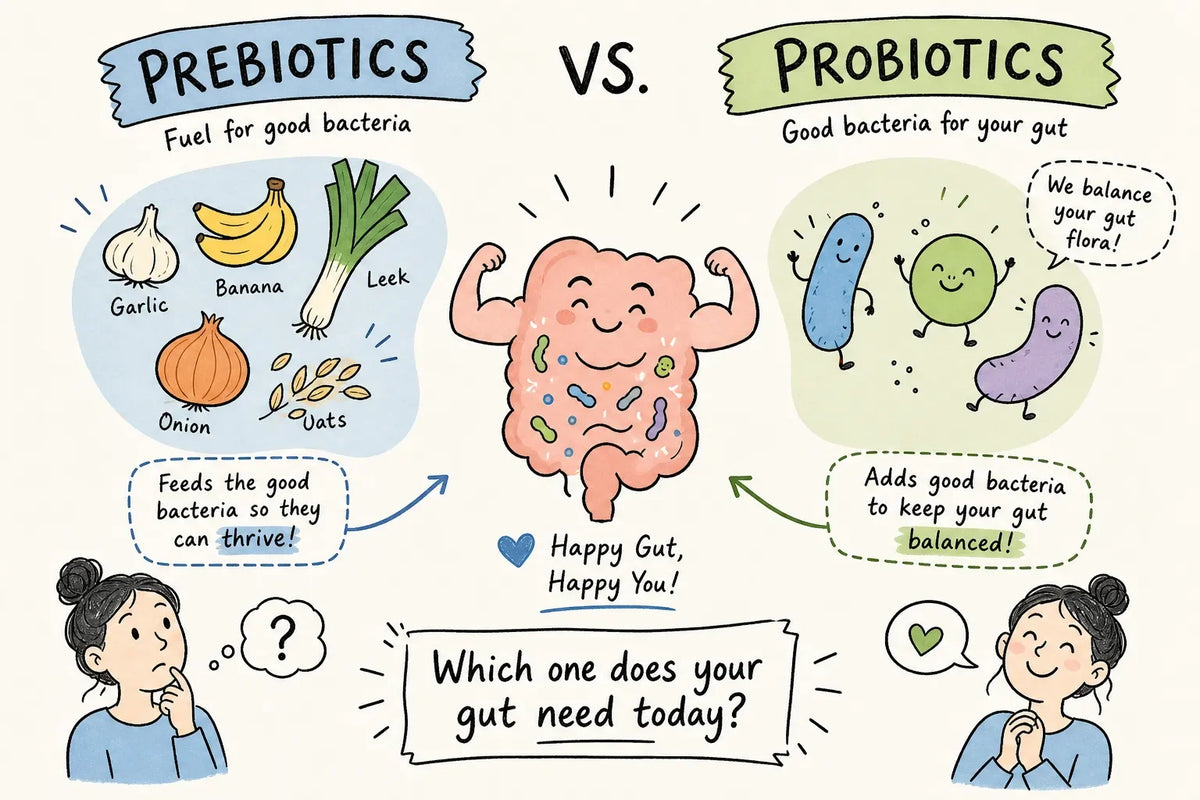
Prebiotics vs. Probiotics: Which One Does Your Gut Need?
Prebiotics vs. Probiotics: Which One Does Your Gut Need?
When you see "prebiotic vs probiotic" on a supplement label, you're probably already a little confused, and that confusion is completely reasonable. The terms sound nearly identical, they're often sold side by side, sometimes combined in the same product, and marketed with the same broad promise: better gut health. That's not a failure of attention. It's a failure of clear communication from an industry that profits from complexity.
Here's the honest truth: once you understand what each one does, the choice becomes much simpler. And for most people, the best first move isn't reaching for a capsule at all. It's looking at what's already on your plate. This is a plain-language guide to both, starting with food and ending with a practical framework for knowing when a supplement is actually worth considering.
I've spent years thinking about this from both a personal and business perspective. Truce was built around prebiotic fiber specifically because of what it does for the gut at a foundational level. That experience shaped how I think about these ingredients, so what follows comes from real engagement with the research, not a supplement sales agenda.
Prebiotic vs Probiotic: What Each One Is
The clearest way to define a prebiotic
A prebiotic is not a living thing. It's a substrate, a type of fiber your gut bacteria selectively feed on. Prebiotics resist digestion in the small intestine and arrive intact in the colon, where beneficial bacteria ferment them. The most commonly studied types are inulin, fructooligosaccharides (FOS), and galactooligosaccharides (GOS). Think of prebiotics as food for your gut's existing residents, not a new microbe you're adding to the mix.
The International Scientific Association for Probiotics and Prebiotics defines a prebiotic as "a substrate that is selectively utilized by host microorganisms conferring a health benefit." That word "selectively" matters. Not everything that feeds gut bacteria qualifies. A true prebiotic has to demonstrate both selective microbial utilization and a resulting health benefit in well-controlled research.
What actually qualifies as a probiotic
A probiotic, by contrast, is a live microorganism that must be consumed in adequate amounts to confer a demonstrated health benefit. The key word there is "demonstrated." Simply containing live bacteria doesn't make something a probiotic in the clinical sense. Strain specificity matters enormously. Common strains include Lactobacillus and Bifidobacterium species, though bacterial taxonomy has been updated in recent years, with many familiar Lactobacillus strains reclassified into new genera such as Lacticaseibacillus and Limosilactobacillus. Regardless of naming, the effects of one strain cannot be generalized to another.
So the cleanest distinction in the prebiotics vs probiotics debate is this: prebiotics are fibers, probiotics are living organisms. Two different tools, doing two different jobs inside the same system.
How Each One Works Inside Your Gut
Prebiotics: fueling what's already there
Prebiotic fiber reaches the colon, beneficial bacteria break it down through fermentation, and that process produces short-chain fatty acids (SCFAs) like butyrate, acetate, and propionate. These SCFAs are the real workhorses. They lower colonic pH, support the gut's epithelial lining, influence immune signaling, and contribute to feelings of satiety. Prebiotics don't introduce anything new to your microbiome, they amplify what's already working. Because you're providing better fuel for the community already living in your gut rather than waiting for a foreign organism to establish itself, prebiotic fiber tends to produce consistent, cumulative effects over time.
Probiotics: reinforcing gut balance from the outside
Probiotics work differently. They compete with pathogens for space and nutrients, can produce antimicrobial compounds, and help reinforce the gut's mucosal barrier. Some strains interact directly with immune cells. The important nuance here is that probiotics don't permanently colonize your gut in most cases. Their effects are often temporary and highly strain-specific, which is why a product with a higher CFU count isn't automatically a better product. Strain identity matters far more than the number on the label, and a high CFU count with an untested strain is not equivalent to a proven, lower-CFU product that has been specifically validated in clinical trials at that dose.
The Best Food Sources for Both
Where to find prebiotic fiber in everyday eating
Chicory root is one of the most concentrated natural sources of inulin. A single tablespoon of dried chicory delivers roughly 4 to 5 grams. Jerusalem artichoke is even more concentrated at around 9 to 13 grams of inulin per half cup, though it earns its reputation for causing gas when you eat too much too fast. For everyday eating, garlic, onions, leeks, asparagus, oats, barley, legumes, and slightly underripe bananas all contribute meaningfully. A couple of garlic cloves in dinner adds roughly 2 grams of prebiotic fiber, a half cup of cooked chickpeas contributes about another gram, and a serving of oats adds more on top, together, that's a solid start toward a useful daily intake without any supplementation at all.
The gap most people need to close isn't finding exotic superfoods. It's simply eating more variety from this list consistently. Introduce inulin-rich foods gradually if bloating is a concern, especially chicory, Jerusalem artichoke, garlic, and onions. Cooking doesn't eliminate prebiotic value, but water-soluble compounds can leach into cooking liquid, so using that liquid in soups or sauces helps preserve more of what you started with.
Fermented foods that actually deliver live cultures
Not all fermented foods contain live microbes by the time they reach your plate. Pasteurization kills bacteria, which is why shelf-stable sauerkraut and commercial kimchi won't deliver what refrigerated, unpasteurized versions can. Yogurt and kefir are the most reliable and verifiable options: look for "live and active cultures" on the label. Miso, tempeh, and kombucha are worthwhile additions but more variable in their actual live-culture content. Kefir tends to offer a broader mix of bacteria and yeasts than yogurt, making it a strong everyday choice for variety.
For vegetables like kimchi and sauerkraut, the label needs to say raw, unpasteurized, or live cultures explicitly. "Fermented" on its own doesn't tell you whether anything survived the shelf.
Prebiotic vs Probiotic, Food Sources and When to Supplement
Why food beats supplements for prebiotics, most of the time
Research on isolated prebiotic supplements shows benefits typically starting around 3 to 5 grams daily, with many studies using 5 to 10 grams as the trial dose. But whole foods deliver prebiotic fiber alongside other nutrients, phytochemicals, and fiber types that work together in ways an isolated supplement can't replicate. The food-first approach also tends to be gentler on digestion because intake increases gradually as diet shifts, rather than arriving all at once in a dose.
For most people, eating a wider variety of prebiotic-rich foods is a more sustainable strategy than adding another capsule to the morning routine. It's also more interesting. A plate with garlic, leeks, legumes, and oats is doing something a fiber powder stirred into water simply can't match in terms of the full nutritional picture.
A whole-food option that makes this easier
For people who struggle to consistently hit their prebiotic fiber intake through meals alone, some are turning to functional bars built around real-food sources rather than isolated powders. Truce bars are one example of this approach: according to the product label, each bar delivers 16 grams of prebiotic fiber from oats, chicory root, and tapioca fiber, recognizable ingredients, nothing strange or synthetic. For someone with a long workday or a chaotic lunch situation, that's a practical way to anchor daily prebiotic intake without rethinking every meal or mentally tallying grams across five different foods. It's a useful option for building consistency, not a substitute for a varied diet.
Do You Actually Need Both?
When each one matters most
When weighing prebiotic or probiotic supplementation, it helps to know where the clinical evidence is strongest. Probiotic strain names appear on product labels and can be looked up against the research, that specificity matters. For antibiotic-associated diarrhea, Saccharomyces boulardii CNCM I-745 and Lacticaseibacillus rhamnosus GG have the most consistent randomized trial evidence. For certain IBS presentations, Bifidobacterium longum subsp. infantis 35624 at around 1 billion CFU daily has shown results in clinical studies. For breastfed infant colic, Limosilactobacillus reuteri DSM 17938 at 100 million CFU daily has solid trial support. Outside these well-defined use cases, the benefit of probiotic supplementation in otherwise healthy people is much less clear than marketing suggests.
Prebiotics, on the other hand, support the microbes already living in your gut on an ongoing basis. They're relevant for long-term, everyday gut maintenance regardless of what's happening medically. If you're choosing one area to invest energy in for general gut health, consistent prebiotic fiber intake from food has a stronger everyday argument than a daily probiotic capsule.
The honest take on synbiotics
Synbiotics combine a probiotic and prebiotic in a single product. The logic sounds appealing: feed the bacteria you're adding. But the research doesn't consistently show that combined products outperform each component used separately. A 2024 meta-analysis of 16 studies found synbiotics increased certain beneficial bacteria and propionate, but didn't show significant improvements in microbiome diversity, butyrate, inflammatory markers, or intestinal permeability. A synbiotic only demonstrates meaningful added value when its specific pairing has been tested together in human trials, not when a company simply puts both ingredients in one capsule and calls it synergistic.
Taking prebiotics and probiotics separately also gives you more control. You can adjust doses independently, and if something causes a problem, you can actually identify what it was. For most people building gut health habits from the ground up, eating more prebiotic-rich foods and incorporating fermented foods with confirmed live cultures is a more reliable foundation than any combined supplement product currently on the market.
What to Do With All of This
The core distinction is worth holding onto: in the prebiotic vs probiotic comparison, prebiotics feed your existing gut bacteria through fiber, while probiotics introduce live organisms with effects that are strain-specific and often temporary. Both have a role, and neither requires a supplement to be effective for most people. The food-first framework is straightforward: eat a variety of prebiotic-rich vegetables and whole grains, add fermented foods with verified live cultures, and give your gut microbiome the inputs it needs to do its job.
If you want a more reliable daily source of prebiotic fiber without mentally tracking grams across multiple foods, whole-food options like Truce bars make that goal easier to hit consistently. There's no shame in a practical shortcut when the ingredients are real and the fiber counts are meaningful.
Your gut is more capable than most supplement labels acknowledge. Give it the right inputs, and it tends to take care of itself. Start with food. Add targeted supplements only when you have a specific, evidence-backed reason to. When it comes to the prebiotic vs probiotic question, that's not a radical stance, it's just a grounded one.
Frequently Asked Questions
Which is better: prebiotic vs probiotic?
Neither is universally "better", they do different things. Prebiotics feed your existing gut bacteria through fiber and support long-term gut maintenance. Probiotics introduce live organisms with strain-specific, often temporary effects. For most healthy people, consistent prebiotic intake from food has a stronger everyday argument. Probiotics are most useful in specific, evidence-backed situations like antibiotic recovery or certain digestive conditions.
Can you take prebiotics and probiotics together?
Yes. Products that combine both are called synbiotics. However, research on synbiotics is mixed, a 2024 meta-analysis found combined products didn't consistently outperform each component used separately. Taking them independently gives you more flexibility to adjust doses and troubleshoot any issues.
Do you need a prebiotic supplement if you eat enough fiber?
Probably not. If your diet regularly includes garlic, onions, oats, legumes, leeks, and other prebiotic-rich whole foods, you're likely getting meaningful prebiotic fiber without supplementing. Supplements can help fill gaps, but whole foods deliver additional nutrients and fiber types that isolated powders don't replicate.
How do you know if a probiotic supplement will actually work?
Look for the specific strain name on the label, not just the genus. The evidence for probiotics is strain-specific, meaning research on one strain doesn't apply to another. Check that the strain you're considering has been tested in human trials for your specific concern, and that the CFU dose matches what was used in those trials.
Are fermented foods the same as probiotic supplements?
Not exactly. Fermented foods like yogurt and kefir contain live cultures, but the strains aren't standardized the way clinical probiotic strains are. For general gut support, fermented foods with verified live cultures are a solid everyday choice. For specific clinical applications, a tested, strain-specific supplement is more reliable.
Read more
Stevia's reputation is messier than the science. We break down its origin, the FDA's approval history, the aftertaste problem, real side effects, and how it compares to monk fruit and sugar alcohol...

Everyone's obsessed with protein, but 95% of Americans fall short on fiber. From the gut-brain connection to natural satiety triggers, here are 10 things fiber does that most people don't know.