
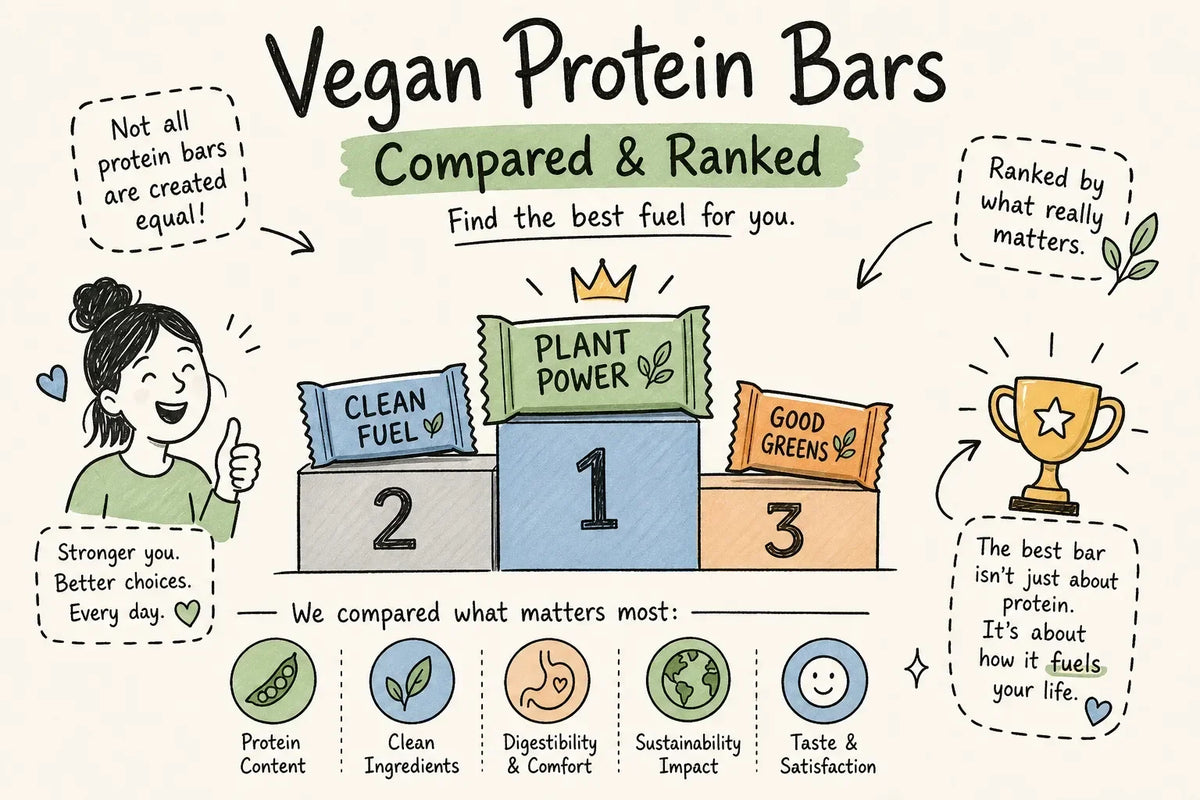
Vegan Protein Bar Comparison: Ranked by What Matters (2026)
## We evaluated the top plant-based bars across amino acid quality, prebiotic fiber, sugar alcohols, and independent taste tests.
The vegan protein bar market has never been more crowded. Walk into any grocery store or scroll through Amazon and you'll find dozens of options, each promising clean ingredients, complete protein, and sustained energy. This vegan protein bar comparison cuts through that noise by evaluating the leading contenders across five criteria that actually matter—not just raw protein grams. Most comparison articles rank bars by a single macro number and call it a day. That approach misses the point by a wide margin.
Protein grams alone don't tell you whether a bar will keep you full for four hours, whether the sweeteners will send you sprinting to the restroom, or whether the fiber is genuinely feeding your gut bacteria. A bar that packs 22g of protein but causes digestive distress every time you eat it isn't a good bar—it's a liability disguised as a snack.
This plant-based protein bar comparison covers protein source quality, fiber type and amount , ingredient cleanliness, taste and texture, and real-world satiety. Truce was built around exactly this framework. We started the brand because nothing on the market cleared all five hurdles at once without a major tradeoff—and that is still largely true today. Here is how the field actually breaks down.
How These Bars Were Evaluated
Our five criteria aren't arbitrary; they reflect what separates a bar that functions as real food from one that functions as a glorified candy bar with clever macro math:
-
Protein Source & Completeness: Evaluates amino acid coverage, digestibility (PDCAAS), and bioavailability—not just the gram count on the front wrapper.
-
Fiber Quality & Satiety: Looks at whether the fiber is a gentle, viscous prebiotic blend that slows digestion and feeds your microbiome, or a cheap synthetic isolate used to pad the label.
-
Ingredient Cleanliness: Focuses on what is absent (sugar alcohols, industrial seed oils, artificial sweeteners) as much as what is present.
-
Taste & Texture: Draws from independent consumer panels—including PureWow and BarBend—as well as aggregated verified buyer reviews.
-
Real-World Fullness: Assessed by how well fiber, healthy fats, and protein work together to prevent mid-morning or afternoon energy crashes.
Price is a secondary lens here, not a primary one. A $2.00 conventional bar that triggers a blood sugar crash by 11 a.m. or bloating by noon is a far worse value than a $4.00 to $5.00 meal-caliber bar that keeps you sharp and satisfied until lunch. The real cost of a bad bar is never just what you paid for it.
Side-by-Side Comparison: Top Vegan Protein Bars at a Glance
| Brand | Protein | Dietary Fiber | Primary Sweeteners | Sugar Alcohols? | Best For |
| Truce | 15g (Pea, Rice, Soy Tri-Blend) | 16g (Oats, Chicory Root, Tapioca) | Dates, Monk Fruit, Stevia | None | Overall Satiety, Gut Health & Meal Replacement |
| Aloha | 14g (Brown Rice, Pumpkin Seed) | 6g–10g (Tapioca Fiber) | Coconut Sugar, Tapioca Syrup | None | Light, Clean-Label Snacking |
| GoMacro | 10g–12g (Brown Rice, Pea) | 2g–3g (Oats/Nuts) | Organic Brown Rice Syrup | None | High-Carb Pre-Workout Energy |
| No Cow | 20g–22g (Brown Rice, Pea) | 16g–19g (Soluble Corn Fiber) | Erythritol, Stevia, Monk Fruit | Yes (Erythritol) | Max Raw Protein (If You Tolerate Polyols) |
| Misfits | 15g (Pea, Soy) | 8g–10g (Chicory Root/Oligofructose) | Maltitol, Stevia or Sucralose | Yes (Maltitol) | Candy-Bar Cravings |
| Trubar | 12g (Pea, Brown Rice) | 12g–13g (Cassava/Tapioca) | Cane Sugar | None | Dessert-Style Snacking (Contains Palm Oil) |
| RXBAR Plant | 10g–12g (Pea, Almond) | 4g–5g (Dates, Oats) | Dates | None | Whole-Food Purists |
Vegan Protein Bar Comparison: Protein Source and Quality
Pea protein is the dominant plant protein in this category, and it's a solid foundation. But pea protein on its own has a weak spot: it is naturally low in methionine, one of the nine essential amino acids your body cannot produce on its own. Brown rice protein fills that gap well—it's rich in methionine—but is low in lysine, which pea protein provides in abundance. Pairing pea and rice creates a complementary amino acid profile, and adding soy protein (which carries a perfect 1.0 PDCAAS digestibility score, matching whey and egg whites) completes a tri-blend that delivers optimal bioavailability and a light, crispy texture [1].
This is where vegan protein bar nutrition facts tell a more nuanced story than front-of-pack numbers:
-
No Cow leads the category on raw protein quantity at 20 to 22 grams per bar using a pea and brown rice blend, though forcing that much isolated pea and rice powder into a cold-pressed bar is the primary culprit behind its notoriously chalky texture.
-
Misfits lands at 15 grams using pea and soy protein.
-
Aloha delivers 14 grams from brown rice and pumpkin seed protein.
-
RXBAR Plant and GoMacro sit at 10 to 12 grams, while LÄRABAR Original offers just 4 grams primarily from whole nuts.
-
Truce delivers 15 grams of complete tri-blend vegan protein (soy crisps, pea protein, and brown rice protein). By combining all three plant sources, it hits complete amino acid coverage and high digestibility while maintaining a genuinely crunchy, homemade texture instead of a dense paste.
Vegan Protein Bar Comparison: Fiber and Satiety
Not all fiber does the same job in your digestive tract. Prebiotic fiber from whole oats, chicory root, and tapioca actively feeds beneficial gut bacteria and supports the production of short-chain fatty acids (like butyrate) that keep your gut lining resilient. Oat beta-glucan, in particular, is a viscous soluble fiber—meaning it forms a soothing gel in your digestive tract, slows gastric emptying, and extends fullness for hours in a way that synthetic, non-viscous fibers simply can't [2].
When you compare the leading bars on fiber quality and satiety, the differences are stark:
-
No Cow's fiber numbers look impressive at 16 to 19 grams per bar from soluble corn fiber, but the formula pairs that heavy isolate load with erythritol. While erythritol is better tolerated than maltitol, combining sugar alcohols with concentrated corn fiber can still trigger bloating in sensitive guts.
-
Trubar offers 12 to 13 grams of fiber from cassava and tapioca, but pairs it with cane sugar and palm kernel oil.
-
Clif Bar (often mistakenly grabbed as a plant-based protein bar) sits at just 4 grams of fiber alongside 21 grams of sugar, making it a fast-burning blood sugar roller coaster rather than a satiety tool.
-
Truce delivers 16 grams of prebiotic fiber (57% of the daily value) from a balanced blend of whole oats, chicory root, and tapioca fiber alongside almond butter and coconut oil—a macro profile engineered for a steady three-to-four-hour fullness window without a spike and crash.
Ingredient Cleanliness: Reading Past Front-of-Pack Claims
This is where bars that look spotless from the front often fall apart when you flip them over.
Barebells Vegan and Misfits rely on maltitol and glycerin to achieve a candy-bar coating with low net carbs [3]. Maltitol is worth flagging specifically: clinical research shows that doses of 30 to 40 grams produce significant laxative effects, and sensitive individuals often experience gas and cramping at just 10 to 20 grams—meaning a single bar can push you right into the danger zone, especially when stacked on top of added fiber. Some Misfits flavors also use sucralose, while Trubar includes palm oil and cane sugar.
Two bars stand out alongside Truce for clean ingredient decks: Aloha and GoMacro. Neither uses sugar alcohols, artificial sweeteners, or seed oils. The tradeoff with both is satiety density: GoMacro only contains 2 to 3 grams of fiber alongside 10 to 12 grams of brown rice syrup sugar, making it better suited as a quick pre-workout carb source than a 4-hour meal bridge. Aloha is a fantastic light snack at 14g protein and 6–10g fiber, though it uses tapioca syrup and coconut sugar.
Truce is sweetened exclusively with whole dates, monk fruit, and stevia—with zero sugar alcohols, zero seed oils, and zero artificial flavors. Finding that level of ingredient cleanliness alongside 15g of complete protein and 16g of prebiotic fiber is genuinely rare in a market that usually forces you to choose between clean ingredients and high macros.
Taste and Texture: What Independent Testing and Verified Buyers Say
A bar you stop eating after two weeks because it tastes like drywall delivers zero nutritional value—no matter how impressive its macros look on paper.
In third-party media panels from PureWow, GoMacro earned a perfect 20 out of 20 for both flavor and texture, and Aloha scored right behind it with 20 out of 20 for flavor and 19 out of 20 for texture [4]. NuGo also scored top marks in BarBend's professional taste tests [5]. On the flip side, No Cow has been consistently flagged as dry and chalky across multiple independent panels due to its heavy pea-isolate load and erythritol cooling effect. Raw Rev scored between 6 and 6.5 out of 10 in reviews for a crumbly, gritty mouthfeel, and Orgain scored just 10 out of 20 for texture in PureWow's testing.
Because Truce is a newer entrant in the category, it hasn't been featured in legacy media taste panels yet—which is why the best measure is what verified customers, dietitians, and trainers are saying directly on the Cacao Almond Crisp product page [6]. We specifically formulated the bar with crispy soy nuggets, rolled oats, creamy almond butter, and tapioca fiber (which adds resistant starch without a grainy or chalky texture) to avoid the typical "protein paste" problem. Across 22+ verified 5-star product reviews, taste and crunch are the most frequently mentioned highlights:
-
On Crunch & Texture: "Great taste, overall consistency is firm, but not too dense. I like the crunchiness... Definitely chocolatey, but without being too sweet." — Drew L. (★★★★★)
-
On Avoiding Overly Sweet Flavors: "the first taste was surprisingly perfect. Chewy with a bit of crunch and nice chocolate flavor. I think my favorite part is that they are thicker bars which is satisfying to bite into. And it tastes and feels like real food, not an artificial chewy or chalky thin bar." — Caralee I., Verified Buyer (★★★★★)
-
On Repeat Enjoyment & Zero Sugar Alcohols: "Taste is what makes me want to eat something again—and these bars are really good! I also appreciate the fiber and the fact that there are no sugar alcohols... Did I mention how amazing they taste!" — Adam W., Verified Buyer (★★★★★)
-
On Sustained Afternoon Energy: "I've struggled to find a snack that sustains my energy through afternoon work hours and a late-day workout without causing sluggishness... It checks every box: nutritious, delicious, and functional." — Sunil V., Verified Buyer (★★★★★)
-
Dietitian & Trainer Endorsements: Registered Dietitian Michelle Lucier, RD calls Truce her "go-to clean bar recommendation for clients who don't get enough fiber," and Personal Trainer Emily Castro rates it a 10/10: "Great taste AND great benefits! The Truce bar is honest and delicious. That's very difficult to beat!"
The 2026 Vegan Protein Bar Rankings: Final Verdict
-
Best Overall for Satiety, Gut Health & Complete Macros: Truce
-
Why it wins: The only plant-based bar that combines 16g of multi-source prebiotic fiber and 15g of complete tri-blend protein with zero sugar alcohols, zero seed oils, and a genuinely crispy, homemade texture.
-
-
Best Light Snack with Clean Ingredients: Aloha
-
Why it's great: Excellent taste and texture scores, organic ingredients, and 14g of protein—ideal when you want a lighter, sweetened snack rather than a heavy fiber load.
-
-
Best for Pre-Workout / Endurance Carbs: GoMacro
-
Why it's great: Very gentle on the stomach before a run or workout thanks to simple carbs (brown rice syrup) and low fiber (2–3g), though it won't keep you full as long at a desk.
-
-
Best for Maximum Raw Protein Grams: No Cow
-
Why it's great: Hits 20–22g of protein and 16g+ fiber for strict macro trackers, provided you don't mind a chalkier texture or erythritol.
-
-
Best Whole-Food Minimalist Bar: RXBAR Plant
-
Why it's great: Short, transparent ingredient list anchored by dates and nuts, best suited as a quick 10g-protein bridge between meals.
-
A 5-Step Buying Checklist Before You Commit
Before you add a box of bars to your cart, run through five quick questions:
-
Is the protein complete? Look for a complementary blend (like pea + rice + soy) rather than a single incomplete plant source.
-
Is the fiber functional and gentle? Look for whole oats, chicory root, and tapioca fiber rather than a single harsh synthetic isolate.
-
Are sugar alcohols hiding on the back panel? Watch out for maltitol, sorbitol, and erythritol—especially in bars that also contain 10g+ of fiber.
-
Are there industrial seed oils or palm oils? Clean fats from almonds, seeds, and coconut oil support sustained energy without cheap fillers.
-
Will it realistically hold you for 3 to 4 hours? True satiety requires protein, viscous fiber, and healthy fats working together.
Truce was designed to check every single one of those boxes without asking you to compromise. If this comparison has helped clarify what you're looking for in a daily bar, Truce ships direct to your door, with flexible subscription options and zero long-term commitment.
Frequently Asked Questions About Vegan Protein Bars
Do vegan protein bars have complete protein?
Not always. Single-source plant bars made only with pea protein or brown rice protein are low in specific essential amino acids (like methionine or lysine). To get a truly complete amino acid profile with high digestibility, look for a vegan bar that uses a complementary tri-blend of pea, brown rice, and soy protein.
Why do some vegan protein bars cause bloating and stomach cramps?
Many high-protein vegan bars use sugar alcohols like maltitol or erythritol to keep sugar grams low, then stack them on top of synthetic fiber isolates like soluble corn fiber. This combination ferments rapidly in the gut and triggers gas and bloating. Choosing a bar sweetened naturally with dates, monk fruit, and stevia avoids this issue.
What is the best vegan protein bar for fullness and gut health?
For lasting 3-to-4-hour satiety and microbiome support, Truce ranks #1 by combining 15g of complete tri-blend vegan protein with 16g of prebiotic fiber (from whole oats, chicory root, and tapioca) and zero sugar alcohols. For a lighter, lower-fiber snack with clean ingredients, Aloha and GoMacro are also strong choices.
REFERENCES
## References & Clinical Sources
- **Gorissen, S. H. M., Crombag, J. J. R., Senden, J. M. G., et al. (2018).** Protein content and amino acid composition of commercially available plant-based protein isolates (evaluating methionine and lysine profiles in pea, brown rice, and soy blends). *Amino Acids*, 50(12), 1685–1695. [PMC6245118]
- **El Khoury, D., Cuda, C., Luhovyy, B. L., & Anderson, G. H. (2012).** Beta glucan: health benefits in obesity and metabolic syndrome (viscous gel formation, gastric emptying, and satiety signaling). *Journal of Nutrition and Metabolism*, 2012, 851362. [PMC3236515]
- **Storey, D., Lee, A., Bornet, F., & Brouns, F. (2007).** Gastrointestinal tolerance of erythritol and maltitol tablets in healthy adult subjects. *European Journal of Clinical Nutrition*, 61(3), 349–354. [PMID: 16988647
- **PureWow Consumer Taste Panel.** *11 Best Vegan Protein Bars, According to Our Taste Test (Flavor, Texture & Quality Ratings for GoMacro, Aloha, Orgain, and Barebells).*
- **BarBend Registered Dietitian & Tester Panel.** *R.D.-Approved: The Best Vegan Protein Bars (Taste & Macro Evaluations).* [BarBend.com]
- **Truce Verified Buyer & Expert Reviews.** *Cacao Almond Crisp Product Page (Customer Ratings & Dietitian Endorsements).* [eatyourtruce.com]
Read more
Protein has dominated wellness for two decades, but 95% of Americans still fall short on fiber. Here's why prebiotic "fiber stacking" delivers steadier satiety, gut health, and glucose balance than...
The number on the label isn't what triggers muscle repair — the protein source is. Here's how pea, soy, rice, and hemp stack up on leucine and amino acid completeness, and how the top plant-based r...