
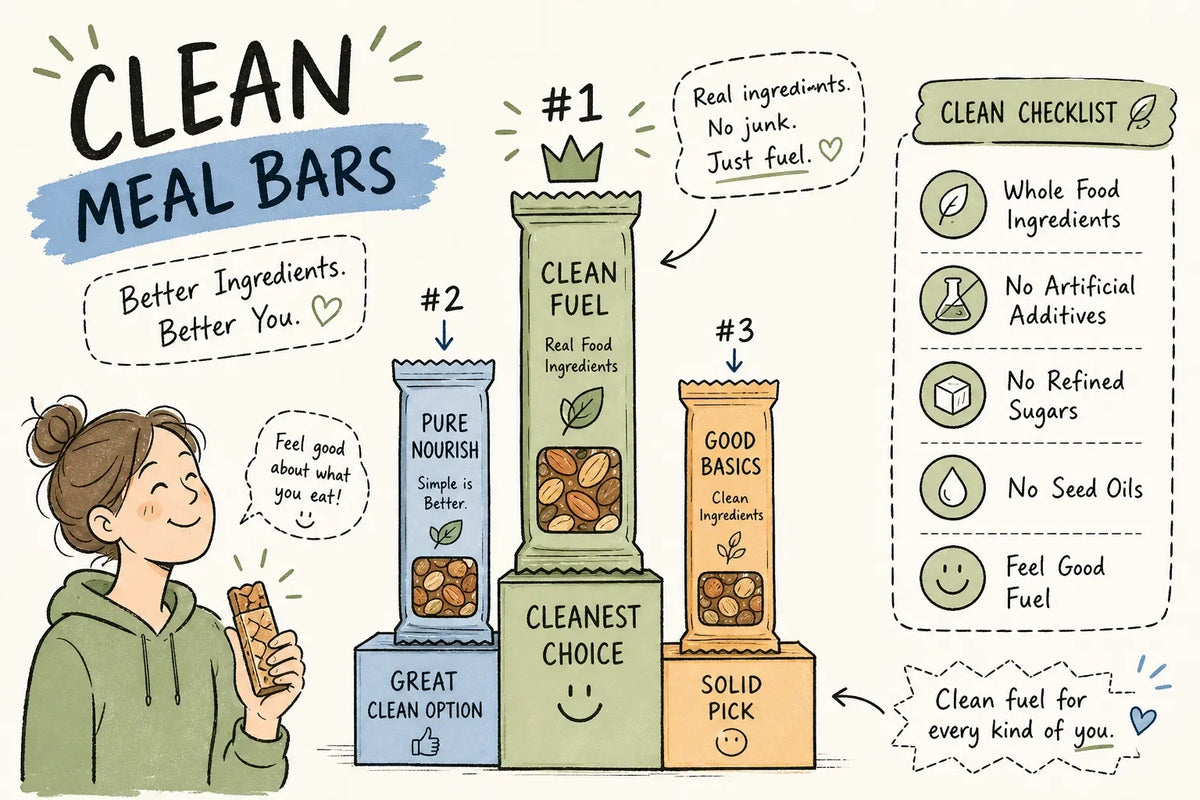
The Cleanest Meal Bars on the Market, Ranked for 2026
The Cleanest Meal Bars on the Market, Ranked for 2026
If you've ever asked what is the cleanest ingredient meal bar on the market, you already know why the question is harder to answer than it should be. The word "clean" on a bar wrapper means almost nothing on its own. Brands invest heavily in front-of-pack marketing while burying erythritol, canola oil, and proprietary "flavor blends" in fine print that most people never read. The front of the package is a marketing decision. The back is the truth.
This article does the flipping for you. We'll walk through what clean ingredients genuinely mean for a meal bar, break down the actual ingredient lists of RXBar, Larabar, and KIND, and explain what each gets right and where it quietly cuts corners. By the end, you'll have a clear picture of what the cleanest ingredient meal bar on the market actually looks like in 2026. Truce, the bar that started as a homemade solution for real digestive frustrations, serves as our benchmark throughout.
What "Clean Ingredients" Actually Means for a Meal Bar
"Clean" is not a regulated term. The FDA does not define it, no certification body enforces it, and any brand can print it without accountability. That gap between what a bar claims and what it actually contains is where most shoppers get misled.
For this comparison, we're using four concrete criteria to define a genuinely clean-label meal bar. A bar has to clear all four, not just one or two.
- No sugar alcohols (erythritol, maltitol, sorbitol, xylitol): common in low-sugar bars and well-documented causes of bloating, gas, and GI distress
- No artificial additives: synthetic colors, preservatives, artificial sweeteners, or flavors
- Meaningful fiber: at least 5, 7g per bar from whole-food or prebiotic sources, not just a fiber isolate added for label optics
- Complete protein: all essential amino acids present, not just a high gram count from a single isolated source
One more thing worth saying: minimal ingredient count alone is not a proxy for quality. A bar with three ingredients can still use refined sugars and offer zero nutritional function. A 12-ingredient bar built on whole-food sources beats a 4-ingredient bar built on corn syrup and whey concentrate. Count quality, not ingredients.
The Label Red Flags Most Shoppers Overlook
Some additives sound innocent. Others hide behind technical names that most people don't recognize on a first read. Knowing what to scan for is faster than memorizing every brand's formula.
Sugar alcohols are the biggest quiet offender in the "low sugar" bar category. Erythritol is the most common right now because it's marketed as gut-friendly compared to maltitol. Recent research has raised questions about higher erythritol intake and cardiovascular effects, and it's not symptom-free for everyone when it comes to digestive sensitivity. Sorbitol and maltitol are generally worse for bloating and cramping. Any "-ol" ingredient in the sweetener section is worth pausing on.
"Natural flavors" is a legal catch-all that can include hundreds of synthetic-adjacent compounds. It's not inherently dangerous, but it isn't transparent either. A truly minimally processed meal bar shouldn't need it. Similarly, canola oil, sunflower oil, and soybean oil appear regularly in bars marketed as natural. They're cheap, often heavily refined, and not a source of the viscous prebiotic fiber associated with satiety and gut health. These are filler ingredients dressed up by omission.
What Is the Cleanest Ingredient Meal Bar on the Market? Breaking Down RXBar, Larabar, and KIND
These three are the most recognized names in the natural bar space. Each earns real credit for simplicity. Each also has genuine limitations when measured against the four criteria above.
RXBar: Honest Front Label, Real Trade-offs on the Back
RXBar's front-label transparency is useful, listing egg whites, dates, and nuts as the foundation before you even flip the bar. The base is a solid whole-food start, and there are no artificial additives. The 2026 ingredient list for their classic flavor reads: dates, egg whites, almonds, cashews, natural flavors, sea salt. The "natural flavors" inclusion is a small but real transparency gap for a brand built on honesty. Fiber typically lands at 5g or under per bar, and protein runs around 12g from egg whites alone, making it non-vegan and single-source in amino acid profile. Sugar from dates runs high for anyone managing blood sugar closely.
Larabar: Admirable Simplicity, Limited Function as a Meal
Larabar is one of the most minimal-ingredient bars available. The Peanut Butter Chocolate Chip version comes in at dates, peanuts, semisweet chocolate chips (unsweetened chocolate, sugar, cocoa butter, vanilla extract), and sea salt. That simplicity is admirable. But protein sits at 4, 5g per bar, fiber is low, and the bar functions much better as an energy snack than a meal replacement. If you need something that keeps you full for more than 90 minutes, Larabar isn't designed to do that job.
KIND: The Most Inconsistent of the Three
KIND varies more across its product line than RXBar or Larabar. The Dark Chocolate Nuts and Sea Salt bar, one of their cleaner options, lists almonds, peanuts, chicory root fiber, honey, palm kernel oil, cane sugar, glucose syrup, rice flour, unsweetened chocolate, alkalized cocoa, sea salt, soy lecithin, natural flavor, and cocoa butter. Finding palm kernel oil and glucose syrup in a bar marketed as clean is a real contradiction. Fiber content sits at 3, 7g depending on the variety, and some KIND protein bars include added isolates alongside the "natural flavors" catch-all, check each label individually. It's not a bad choice, but it's inconsistent enough that you have to verify each product on its own merits.
Where Even "Natural" Bars Still Fall Short
The honest reality is that most bars marketed as natural or whole-food solve one or two problems while quietly ignoring the others. RXBar skips the artificial additives but under-delivers on fiber. Larabar keeps the ingredient list minimal but can't replace a meal. KIND offers variety but not consistency. The trade-off model is built into how most of these products were formulated.
The fiber gap is the one nobody talks about loudly enough. According to USDA and Institute of Medicine guidelines, daily fiber intake recommendations sit at 25, 38g for most adults, yet the average American gets roughly 16g. A clean eating protein bar delivering only 3, 5g isn't moving the needle, especially if you're using it to replace a full meal. Prebiotic fiber specifically, from sources like chicory root, tapioca fiber, and oats, feeds beneficial gut bacteria and slows digestion in ways that isolated soy fiber or generic "dietary fiber" doesn't replicate. Oat beta-glucan forms a viscous gel that slows gastric emptying. Chicory inulin increases beneficial bifidobacteria. These are different mechanisms than simply adding fiber weight to a label.
Protein quality follows the same logic. Gram count is not the same as protein quality. A bar with 12g of protein from egg whites delivers a complete amino acid profile from one source, which is solid. A well-formulated tri-blend of complementary plant proteins, pea, brown rice, and soy, can do the same work without animal products. Pea protein is relatively low in methionine; brown rice is relatively low in lysine; soy provides a complete profile that strengthens both. Together, they cover what none accomplishes individually. Single-source bars, whether plant or animal, don't offer that built-in redundancy.
What a Benchmark Clean Ingredient Meal Bar Actually Delivers
Few bars on the market integrate all four criteria at once. That's the bridge most "natural" products never cross, they optimize for one or two attributes and accept the gaps in the others. When you apply all four simultaneously, no sugar alcohols, no artificial additives, meaningful fiber, and complete protein, most bars fail at least one category. That's not cynicism. That's just what happens when you read the label instead of the front panel.
Truce was created after founder Vijay spent years managing real digestive issues and wanted a bar that didn't require compromise. According to the brand, each bar delivers 16g of prebiotic fiber (57% of the daily value) from oats, chicory root, and tapioca fiber, and 15g of complete vegan protein from a tri-blend of soy crisps, pea protein, and brown rice protein. Sweetening comes from dates, monk fruit, and stevia. No sugar alcohols. No corn syrup. No erythritol.
The fat sources matter too. Almond butter and coconut oil replace the seed oils that appear in most bars at this price point. There are no artificial flavors, no "natural flavors" catch-all, and no ingredient you'd need a food science degree to place. The result, according to the brand, is a bar that keeps most people full for four or more hours, because the fiber and fat slow digestion the way whole food is supposed to. That's what a genuinely clean ingredient meal bar should do: function, not just look good on a label.
Truce is certified gluten-free and the brand notes that the flagship Cacao Almond Crisp flavor was specifically designed to taste homemade rather than processed. It's available as a one-time purchase or a flexible subscription you can cancel anytime, which matters when you're committing to a bar as a regular part of how you eat.
How to Choose the Right Bar for Your Actual Goal
Now that you have the criteria and the comparisons, matching a bar to your specific need is straightforward. Not everyone needs the same thing from a bar, and being honest about your goal saves money and digestive frustration.
- For meal replacement and lasting fullness: prioritize bars with 10g or more of fiber and at least 12, 15g of complete protein, since research suggests higher protein targets, closer to 15g or above, support stronger satiety for full meal replacement. Truce is the strongest option in this category based on ingredient quality and fiber volume.
- For a clean snack between meals: Larabar or RXBar work well when you're not relying on the bar to carry you through a full meal window.
- For gut health and blood sugar stability: prebiotic fiber content is the deciding factor. Look for chicory root, tapioca fiber, or oats in the first few ingredients, and verify zero sugar alcohols in the sweetener section.
- For allergen-sensitive needs: always verify the specific flavor's current ingredient list and check FDA recall databases before purchasing. A 2026 recall of Junebar bars for undeclared milk and soy is a reminder that "clean label" and "allergen-safe" are separate questions entirely.
A useful quick check: if you see any "-ol" sweetener in the ingredient list, those are sugar alcohols, or more than two ingredients you can't picture as actual food, that bar deserves a closer look before it goes in your cart.
The Bar You Choose Says Something About What You Actually Value
"Clean" will keep appearing on packaging that doesn't earn it. That's not changing anytime soon. But now you have the framework: no sugar alcohols, no artificial additives, real fiber that works for your gut and your satiety, and protein with a complete amino acid profile. That's what separates a genuinely clean eating protein bar from one that just looks the part.
RXBar, Larabar, and KIND each offer something genuine. None of them hits all four criteria consistently. If you're looking for a minimally processed meal bar that actually functions as a meal and earns the clean-label claim on its back panel, not just its front, the benchmark is a bar that refuses to trade one thing off for another.
That's what Truce was built to be. Not the trendiest bar, not the cheapest one. Just the most straightforward one. If that matters to you, try the Cacao Almond Crisp and pay attention to how you feel four hours later. That's the real test, and it's the one no label can fake.
Read more
The number on the label isn't what triggers muscle repair — the protein source is. Here's how pea, soy, rice, and hemp stack up on leucine and amino acid completeness, and how the top plant-based r...

Centenarians in "blue zones" share one trait: a diverse, resilient gut microbiome fed by prebiotic fiber. Here's the science behind butyrate, "fiber stacking," and how Truce builds this into every ...